Updated August 25, 2026. Microsoft postponed the exchange policy change we originally wrote about in November 2023. The new date is February 1, 2027, and the terms changed. This post reflects Microsoft's current guidance.
Azure Reserved Instances remain one of the strongest cost levers you have, cutting as much as 72% off pay-as-you-go pricing on a 1- or 3-year commitment. What's changing is the flexibility that sits behind them. Starting February 1, 2027, Microsoft ends reservation exchanges for any Azure service that a savings plan already covers.
What Microsoft Announced
Microsoft first flagged the deprecation of reservation exchanges in October 2022, with a start date of January 1, 2024. That date came and went. Microsoft postponed the change, then reset it to February 1, 2027 in a July 2026 announcement. The official policy documentation now carries the same date.
What Changes on February 1, 2027
If a savings plan covers the service, the matching reservation stops supporting exchanges. Three details shape what you do between now and then:
- One final exchange. Any active reservation for an affected service that you bought before February 1, 2027 keeps the right to one last exchange after that date. Once you use it, the resulting reservation can't be exchanged again.
- New purchases lose the option. Reservations bought on or after February 1, 2027 for an affected service can't be exchanged at all.
- The scope keeps growing. As Microsoft adds services to savings plan eligibility, reservations for those services fall under the same policy automatically.
Exchanges work normally right up to February 1, 2027 under the current policy.
Which Services Are Affected
As of Microsoft's announcement, the change applies to reservations for these compute services:
- Azure Virtual Machines, including exchanges between non-premium and premium storage
- Azure Dedicated Host
- Azure App Service
And these database services:
- Azure Database for PostgreSQL
- Azure Database for MySQL
- Azure DocumentDB
- Azure Cosmos DB
- Azure SQL Database
- Azure SQL Managed Instance
What Stays the Same
Plenty, and this is where most of the worry lands in the wrong place:
- Instance size flexibility for virtual machines is untouched.
- Reservations remain available to purchase and renew. For stable, predictable workloads they're still the right call.
- The cancellation policy doesn't change. The $50,000 USD cap on canceled commitment in a rolling 12-month window per billing profile or enrollment still applies.
- Savings plan trade-ins carry no deadline. You can trade a reservation in for a savings plan at any time.
- Services outside savings plan coverage aren't affected. Azure VMware Solution is the clearest example, along with products approaching end of life and cloud environments where savings plans aren't offered.
Planning for the Future
You have the runway to sort this out deliberately. Before February 2027, work out which of your workloads need the flexibility an exchange provides, because a savings plan serves those better anyway.
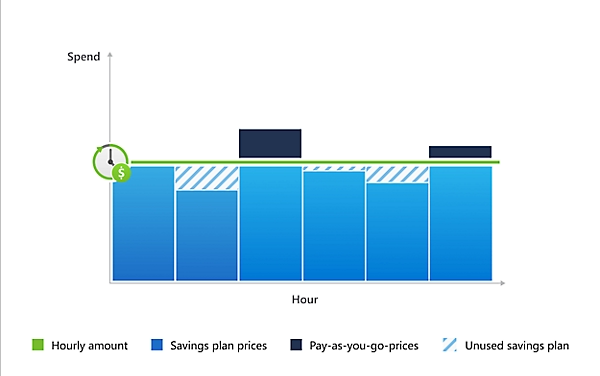 The Azure Savings Plan for Compute grants reduced prices on select Azure compute resources in exchange for a 1- or 3-year commitment to a specified hourly spend. The discount is smaller than what certain Reserved Instances deliver, but it applies automatically across eligible services and regions. On dynamic or evolving workloads, most teams come out ahead trading those percentage points for coverage that follows the workload.
Reservations still win on predictable, steady-state infrastructure. Most organizations we work with run both. Sort your commitments into the right bucket now and the February 2027 change costs you nothing.
How CloudServus Can Help
As a top 1% Microsoft Solutions Partner, we run this analysis for our customers regularly. Our Azure Cost Optimization Assessment maps your existing reservations against the affected service list, identifies which commitments belong in a savings plan, and tells you where to spend your one final exchange.
You have until February 1, 2027, which sounds like a long time and isn't once you account for renewal cycles. Contact CloudServus to start your Azure Cost Optimization Assessment.